.webp)

Pre-Primary - Child Aged 3 - 6 Years

_gif.gif)

Exercises of Practical Life
The Exercises of Practical Life in the Montessori method bridge the child’s home environment and the playschool classroom. At Kinfolk Montessori, we nurture these activities as they deepen control of movement, cultivate independence, and strengthen the foundational skills needed for more advanced Montessori materials.
Exercises of Practical Life encourage children to concentrate, work independently, care for their space, and complete tasks with confidence. These activities play a vital role in building a child’s self-confidence and self-esteem.
Practical Life activities branch out into four major areas: control of movement, care of the self, care of the environment, and grace and courtesy.

Sensorial
The senses act as gateways to intelligence. Sensorial materials give children rich experiences in perceiving distinctions between similar and different things. Over time, children learn to grade a set of similar objects that differ in a regular and measurable way—from most to least. Each piece of material typically isolates one fundamental quality perceived through the senses, such as color, geometric shapes and solids, dimension, texture, temperature, weight, or taste.
Precise language—such as loud/soft, long/short, rough/smooth, circle, square, cube, etc.—is introduced alongside these sensorial experiences, helping children describe what they observe and making the world around them even more meaningful.


Language
The Montessori approach provides a thoughtfully designed program using a variety of activities such as songs, games, poems, stories, and classified language cards to help the child master language.
Preparation for writing begins with the Exercises of Practical Life and sensorial activities. These also help the child distinguish the different sounds that make up a language. The symbols of the alphabet are introduced to children first, followed by their corresponding sounds. Children hear the sound, see the symbol, and feel it by tracing the sandpaper letters. The concrete materials of the Montessori method encourage the child to form words, then phrases, sentences, and finally, stories.


Mathematics
Precise Montessori materials help children understand abstract mathematical ideas by allowing them to work with and experience their concrete forms. By the age of three, a child’s mind has already been awakened to mathematical concepts through sensorial activities.
In the Montessori House of Children, number activities are introduced through hands-on materials, creating natural connections to geometry, algebra, and arithmetic. Children learn the laws of the decimal system using the Golden Bead materials and are then introduced to the four operations—addition, subtraction, multiplication, and division—through concrete, tactile experiences. A variety of materials and activities support children in memorizing basic combinations for all four operations as well.
Montessori fraction materials use hands-on tools like fraction circles to help children understand parts of a whole, building a strong base for abstract math concepts


Art
Painting, color mixing, and collage are just some of the activities offered to teach the care and use of art materials, encourage creativity, and inspire joy in creating.

Culture
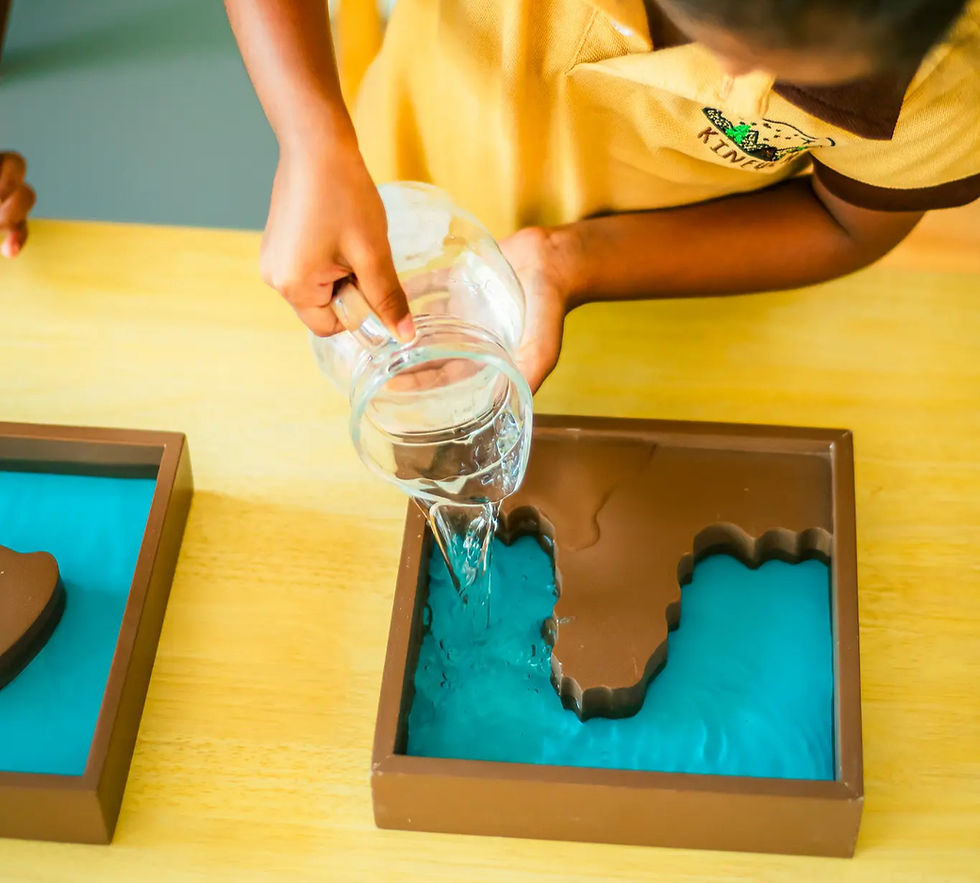
Children are introduced to the richness of world cultures through hands-on explorations in geography, science, and nature. Using wooden puzzle maps, real-world pictures, and interactive activities, children gain an understanding of the seven continents and the diversity they hold. Songs, stories, and games are woven into daily routines as we take a closer look at different regions, traditions, and people. Major landforms and water forms are explored using miniature model forms, giving children concrete, meaningful experiences.
Science work further deepens their cultural understanding by connecting them to the natural world. Children explore plant and animal life from environments across the globe, developing love and respect for all living things. In Botany, they study trees, leaves, seeds, and flowers, including the classification of leaf shapes using the Montessori leaf cabinet. Observing, comparing, and describing natural specimens nurtures curiosity and fosters a lifelong appreciation for nature and the interconnectedness of our world.


Music and Movement
A joyful space where children come together to sing, perform, and grow. Each term, our talented young performers showcase their learning through special performances for families and friends.
Through music, we promote confidence, teamwork, and support the development of language and communication skills. We love music and aim to weave it into our daily school life—because every day is better with a song.


Circle Time
At Kinfolk, we pay special attention to providing quality experiences during circle time. A variety of eye-hand coordination songs, music-based activities, and songs that integrate body movements with rhythm are introduced to the children.
Circle time provides opportunities for singing, movement, listening, exploring musical instruments, and learning musical concepts.

